Hit enter to search or ESC to close
Close Search
eeko systems
  • Get Started
0
Menu
  • Overview
  • Features
  • Results
  • Get Started
  • 0
    was successfully added to your cart.
Prompt Engineering vs. Fine-Tuning: When Each Approach Wins Prompt Engineering vs. Fine-Tuning: When Each Approach Wins
Insights

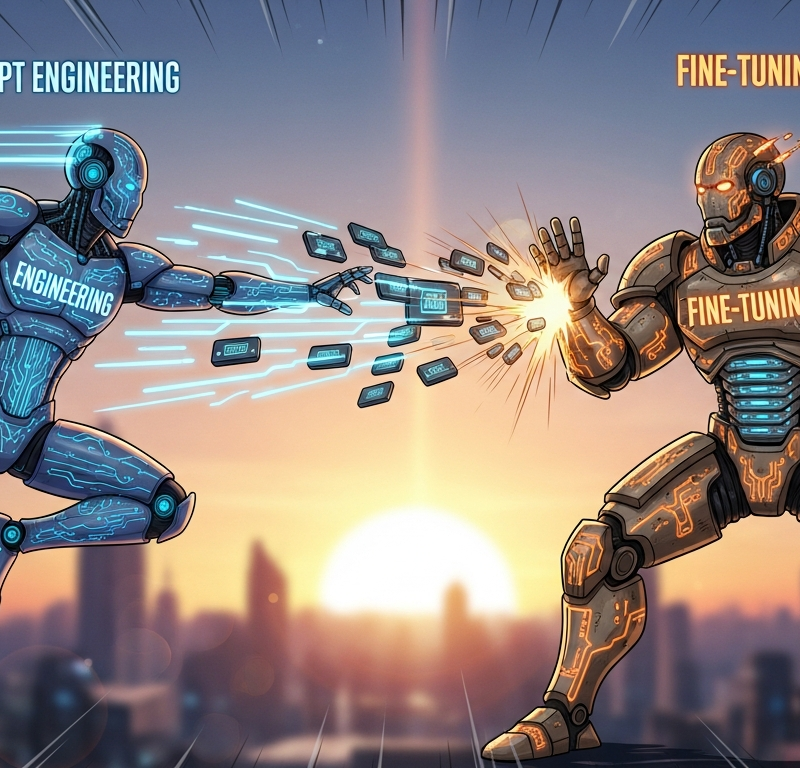
Prompt Engineering vs. Fine-Tuning: When Each Approach Wins

Create a 3-Month Plan to Modernize Your Business with AI Create a 3-Month Plan to Modernize Your Business with AI
Insights

Create a 3-Month Plan to Modernize Your Business with AI

7 Neural Network Optimization Techniques You Aren’t Using Yet 7 Neural Network Optimization Techniques You Aren't Using Yet
Insights

7 Neural Network Optimization Techniques You Aren’t Using Yet

Prompt Engineering vs. Fine-Tuning: When Each Approach Wins Prompt Engineering vs. Fine-Tuning: When Each Approach Wins
Insights

Prompt Engineering vs. Fine-Tuning: When Each Approach Wins

How to Rank in ChatGPT: How GEO, AEO, & AIO Are Rewriting SEO How to Rank in ChatGPT: The New Era of GEO, AEO, and AIO
Insights

How to Rank in ChatGPT: How GEO, AEO, & AIO Are Rewriting SEO

Ranking SEO-Optimized Content With AI Agents for Local Businesses u7765179287 make a comic illustration of businesses being dis 35caf32d f80f 49cc 93f3 1306e969b832 1
InsightsUse Case

Ranking SEO-Optimized Content With AI Agents for Local Businesses

Preserving Civil Liberties in the Age of AI, Big Tech, and Big Data A Quiet Erosion: Preserving Civil Liberties in the Age of AI, Big Tech, and Big Data
Insights

Preserving Civil Liberties in the Age of AI, Big Tech, and Big Data

End of the Old Economy: How the AI Marks the New Industrial Revolution and Why We Must Rethink Human Purpose The Death of the Old Economy Every few centuries, civilization experiences a rupture so vast it forces humanity to reinvent itself. The agricultural revolution taught us to stay in one place. The industrial revolution taught us to build machines. The digital revolution taught us to compute. Now, artificial intelligence is teaching us to think differently—and in doing so, it’s dismantling the foundations of the old economy faster than most realize. The old economy was built on scarcity, effort, and predictable value exchange. A worker exchanged hours for wages. A company sold goods or services that required human labor to produce. Knowledge was valuable because it was hard to acquire; expertise was the currency of the professional class. But AI doesn’t respect that equation. In the new economy, knowledge is infinite, labor is automated, and creativity itself can be simulated. The old pillars—education, work, and even identity—are collapsing under the weight of an intelligence that can replicate human capability without the human. The Great Unbundling of Human Labor Industrialization replaced muscle with machines. AI replaces cognition with code. Every knowledge-based industry—law, medicine, marketing, finance, design—is being quietly unbundled. The cognitive work once requiring years of training can now be completed in seconds. Junior analysts, copywriters, paralegals, and even software engineers are witnessing the same dislocation factory workers experienced in the early 1900s. This isn’t just automation—it’s cognitive commoditization. When every organization can summon infinite intelligence on demand, human contribution must evolve from doing to deciding. The new scarce resource isn’t knowledge—it’s judgment. AI is the new steam engine. It powers everything, but it also burns through the old ways of working. Just as the spinning jenny rendered the artisan weaver obsolete, generative AI is rendering the rote knowledge worker redundant. A Productivity Explosion Unlike Any Before The difference this time is velocity. The industrial revolution unfolded over a century; AI’s revolution will unfold in less than a decade. A single individual can now operate with the leverage of a 50-person team. Entrepreneurs are building billion-dollar companies with no employees. Corporations are collapsing middle management because coordination costs—the friction that once made large organizations efficient—are being erased by automation. The economic effects will be profound: Deflationary productivity: The cost of intelligence, content, and computation approaches zero. Power law economies: Individuals and companies that effectively harness AI will capture outsized value. Decentralization of production: Geography, infrastructure, and even scale will matter less than imagination and execution speed. The result isn’t just more efficiency—it’s a phase shift in how civilization creates value. We’re entering an era where economic output grows exponentially while traditional employment contracts shrink. The Meaning Crisis in an Age of Automation When machines can think, what is left for humans to do? This question is not philosophical indulgence—it’s existential necessity. For centuries, work has been humanity’s organizing principle. It gave us purpose, identity, and belonging. The Protestant work ethic fueled capitalism’s rise; it defined virtue as productivity. But if productivity no longer requires people, that moral structure collapses. The 21st century’s great challenge isn’t unemployment—it’s meaninglessness. AI is stripping away the illusion that human value lies in efficiency. Our worth can’t be measured in output when machines can outproduce us infinitely. The new frontier is authenticity, intuition, and connection—traits machines can mimic but not embody. This transition will be painful. As with all revolutions, institutions will resist change. Universities will cling to outdated credentialing systems. Governments will struggle to redefine labor laws. Individuals will experience an identity crisis as job titles disappear faster than new ones are invented. But beneath the chaos lies a deeper opportunity: the rediscovery of what it means to be human. Rethinking Human Purpose To navigate this transformation, society must reimagine the human role—not as a cog in the economic machine, but as the designer of meaning itself. AI will handle execution; humans must handle direction. The skill of the future is not coding—it’s philosophical creativity: the ability to ask questions no machine would think to ask, to synthesize across disciplines, to imagine futures worth building. We’ll need to cultivate new kinds of literacy: Moral literacy to decide how we use autonomous systems. Emotional literacy to connect in an age of digital detachment. Systems literacy to understand how algorithms shape society. Creative literacy to wield technology as a tool of expression, not replacement. Our purpose must shift from producing value to defining it. The next era will belong to those who can fuse human insight with machine capability—the augmented humans, not the replaced ones. A Civilization in Transition AI isn’t the end of humanity—it’s the end of human narrowness. Just as the printing press democratized knowledge, AI is democratizing intelligence. It will empower billions who were once excluded from opportunity. But it will also challenge every assumption about how society distributes wealth, status, and purpose. We stand at the threshold of a civilization upgrade. The question is not whether AI will take our jobs—it’s whether we will evolve fast enough to take on our new roles as architects of meaning in a post-labor world. If the industrial revolution mechanized the body, the AI revolution is mechanizing the mind. And just as humans transcended the factory, we must now transcend the spreadsheet. Our greatest invention is forcing us to confront our greatest question: When intelligence is abundant, what will make life valuable?
Insights

End of the Old Economy: How the AI Marks the New Industrial Revolution and Why We Must Rethink Human Purpose

How AI is Redefining Coaching and Therapy How AI is Redefining Coaching and Therapy
Insights

How AI is Redefining Coaching and Therapy

Case Study: Leveraging AI to Boost Google Ads Performance by 30% ai in google ads and ppc
Use Case

Case Study: Leveraging AI to Boost Google Ads Performance by 30%
  • Previous
  • 1
  • 2
  • 3
  • 4
  • 5
  • 6
  • Next

Building Stronger, More Connected Teams

Overview
Features
Results
Changelog
Privacy Policy

©2026. All rights reserved.

Close Menu
  • Overview
  • Features
  • Results